


-
Bracing is the bass bars on the top. Parallel, X braced, single traverse, and others come to mind. Normally they are not kerfed but Gibson did them sometimes. I would not want kerfed bracing not enough support.
Kerfed linings are another think entirely that is glued surface around the sides for the top and back. They can be solid but are normally kerfed. I don't own any carved tops with solid linings, and they are rare, but apparently some builders find them better for sound. I do know that Hollenbeck was most adamant that when the top was glue to the sides it was under no stress or tension. It has to line up and he set the top on the sides, and it was so even you could not get a thin slice of paper to go in-between. his reasoning was that this allowed the top to vibrate the fullest at the point when carved the top.
-
08-07-2025 04:01 PM

-
I think kerfing almost 100% was used in wood that was not straight. So top braving would never be kerfed. Why would it? The whole point is to make it easier to form curves. Thus, whether something was kerfed or not always refers to the parts that join the top to the sides.
Further, Gibson began building their instruments with solid bracing and lining and eventually, moved to kerfed.
And it prolly wasn't like a light switch that they changed overnight.
-
Gibson have been known to use kerfed bracing. ie slits are cut into them so they bend to the shape of the top and back. It was cheaper to do than carving.
 Originally Posted by pawlowski6132
-
Linings in old stringed instruments such as violins were traditionally solid basswood lines and bent with water and heat. Older Spanish classical guitars used individual blocks or tentallones to couple the back and top to the rims. Kerfed linings were an innovation to automate this approach. The use of Spanish Cedar (a Cypruss actually) was common. Reverse kerfed linings attempt to marry the stiffness of solid linings with the ease of installation of kerfed linings.
You asked me why Gary was using kerfed linings vs. solid linings did you not? The thread that you posted to substantiate your claim that 1920s L5s used solid linings was a post on kerfed top braces. Gibson did use kerfed top braces in a later era to ease the time and skill required to fit them in a factory setting. That was what the thread that you posted was about. I believe that Gary is using the correct lining approach.
Originally Posted by pawlowski6132
-
I've never seen kerfed top bracing on a solid wood carved arch top by Gibson. They might exist but...
-
Perhaps it's just some of their laminates. Originally Posted by pawlowski6132
-
I am beyond confused.
You asked me why I chose kerfed linings? You said that an L5 would have solid and not kerfed linings. YOU posted the link to this thread on kerfed bracing in post #21.
Gibson's use of kerfed bracing in vintage archtops
on kerfed top bracing. I showed you a photo of a Loar era L5 with kerfed linings. You now say you have never seen kerfed top bracing.
Originally Posted by pawlowski6132
-
Bracing is the pieces of wood that form the x or parallel attached to the middle of the top
Those are solid
-
Thanks for derailing an enjoyable and informative thread (with great pictures!) into a silly dispute based on your argument that "I've never seen it so it doesn't exist, and if it does it shouldn't because it's wrong." Originally Posted by pawlowski6132

-
They are solid wood ( as opposed to laminated) but some are kerfed. One often reads that kerfed braces can break. I think there is a thread somewhere on this forum about a broken kerfed brace on an ES175. Originally Posted by pawlowski6132
-
Go to 3:34
I'm not wrong.
-
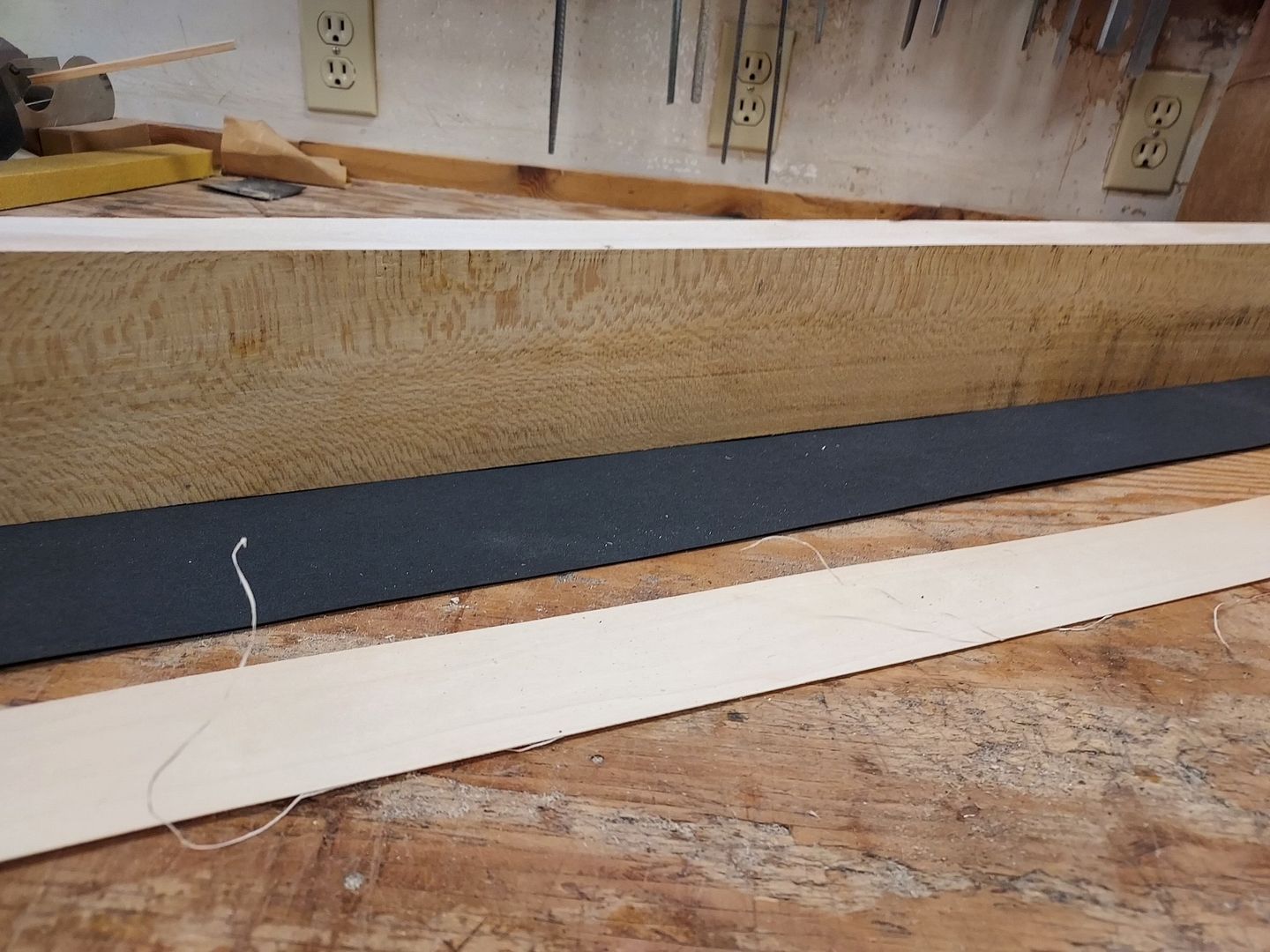
Unlike the original Kalamazoo namesake, Gary is making the bindings and purflings for this instrument using hard and chatoyant Ceylon Satinwood for the bindings and curly Maple with black fiber for the purflings.

-
Gary, has routed the closed “box” and installed black fiber/maple/black fiber purflings and chatoyant, mottled, ceylon satinswood bindings. You can see the beautiful fiddleback curl in the quartersawn red maple back and sides and the medullary rays in the sitka spruce top with body complete in “white”.
-
Those are glue stains, aren't they? Not to pick on the fact there are any ... I'm always envious how pro woodworkers can allow these to happen and not let a trace of them appear in the finished product ... Originally Posted by iim7V7IM7
-
Yes, likely residual titebond 1. They will be scraped and sanded away before finishing begins….

-
Hey for what it's worth, there's a really good chance I'm going to be in his shop this week. Do you want me to ask any questions or get additional pictures?
-
Thanks, but no. Gary and I are in regular contact.
Originally Posted by pawlowski6132
-
Cool I'll take a look at your guitar I'll just keep it to myself. Originally Posted by iim7V7IM7
I'm also planning to bring my Daniel Slaman 1925 copy in my Gibson 1929 L5. Gary has the exact same guitar almost that he's building for this guy here. I'm going to try to compare the three.
If anybody is interested hit me up I might be able to share the videos.
-
Have fun!
-
Gary has begun to fabricate the fretboard and neck. Like many luthiers, he likes to make the fretboard before the neck, so he gets the neck taper right when he bandsaws the neck. Wouldn't want to cut the neck narrower than the fretboard. (Doh!).
Here is the slotted ebony fretboard blank with the Ceylon Satinwood binding and Maple Black Fiber Purflings.
The 24-3/4” scale fretboard has is body end shaped, bound and purfled.
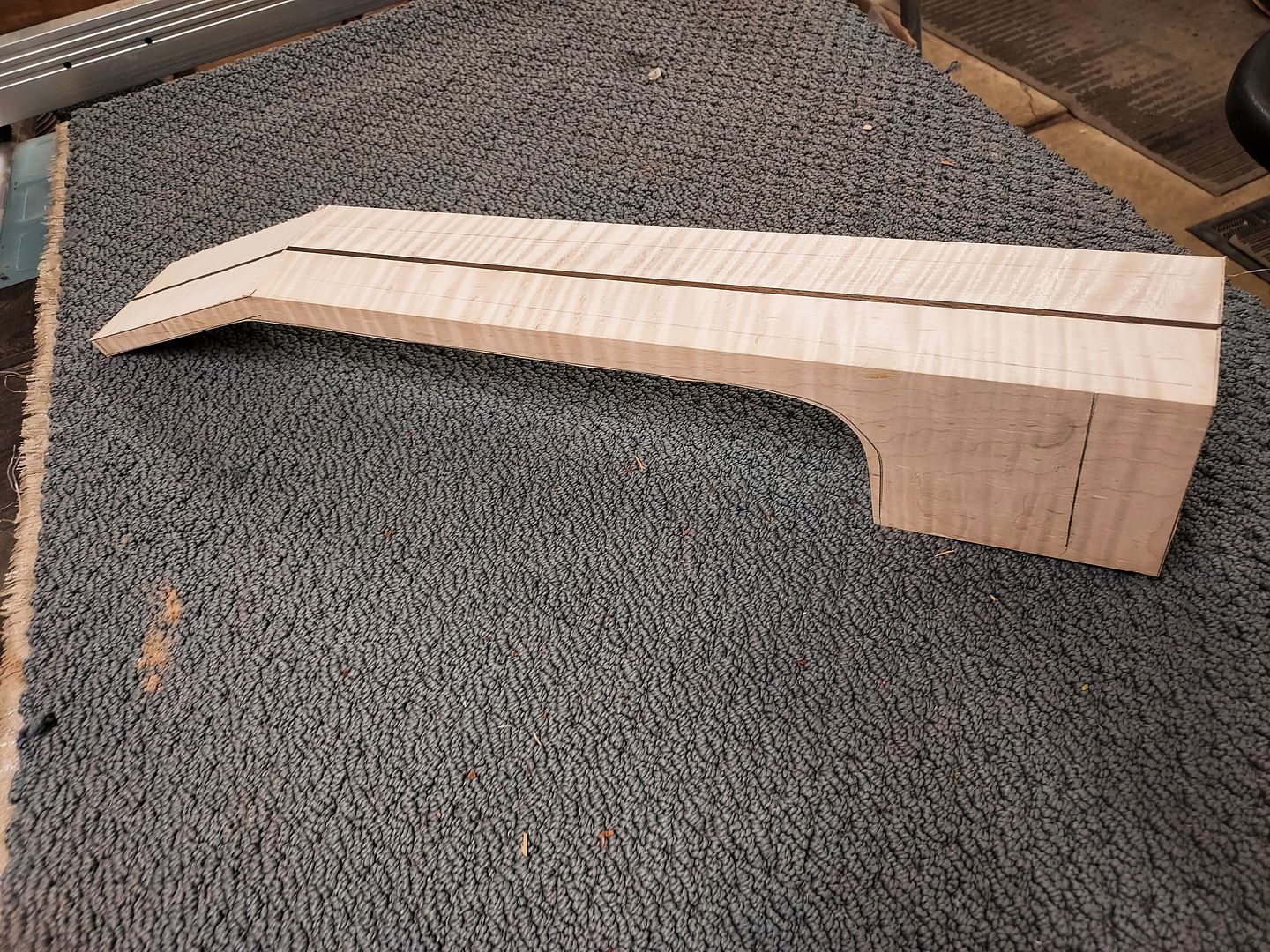
Here is the curly Red Maple neck blank and Black Walnut center strip laminate.
The neck blank, laminated up, glued and clamped.
Using the bandsaw to cut out two neck blanks.
The beautiful flamed curl of the Red Maple against the contrast of the Black Walnut.
Installing an Allied double action truss rod.
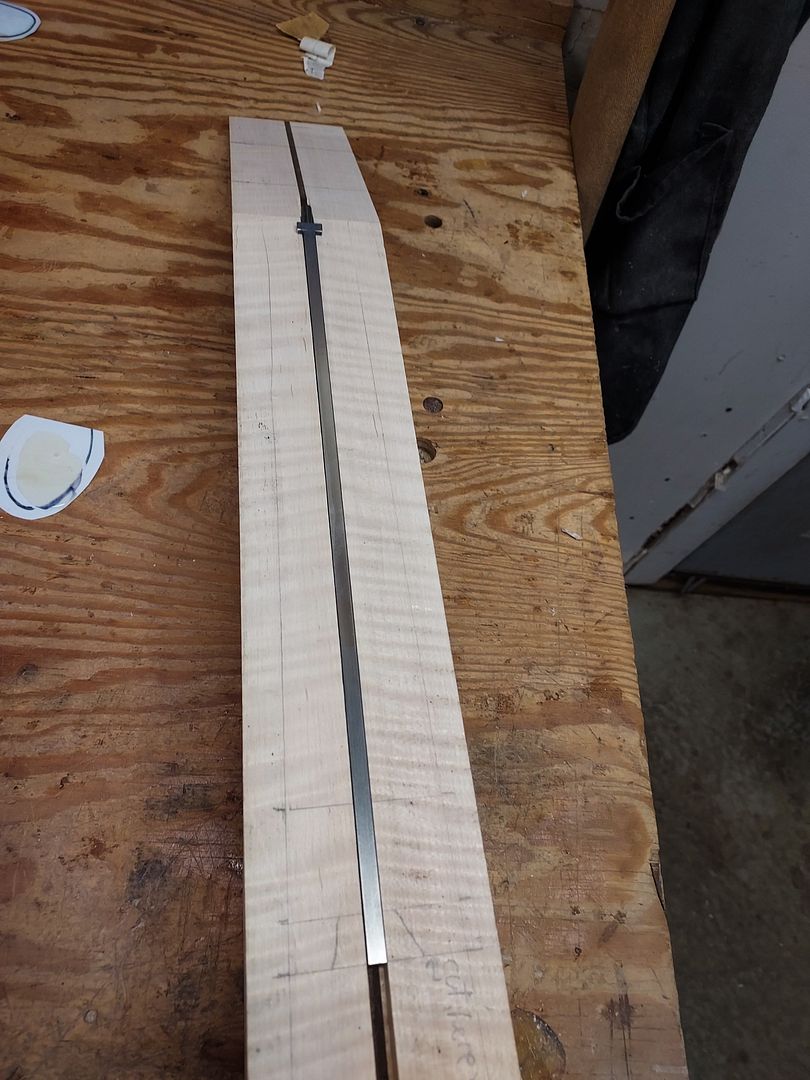
Finished Neck Blank ready for fretboard installation ahead of shaping.
-
I received a message from Gary today that he was able to spend some time at George Gruhn’s shop and was able to examine, play and handle three 1920s Gibson L5s at his leisure. As you can imagine, he felt like it was a once in a lifetime experience.
The guitar bridges were all two footed and the saddles were right around 1" in height, or a bit more. There was more clearance under the fretboard extension than he had expected. Also, the profile of the saddle wasn't quite what is usually seen. Here is a photo of the one that had the top of the original Ebony saddle replaced with Ivory saddle. It has the same stepped pattern for intonation as the other two L5s, but is easier to see in a photo because of the light color.
-
Indeed, that looks like a stepped version of the simple, "slanted" saddle that I associate with the use of a plain 3rd string. Originally Posted by iim7V7IM7
That is one gorgeous back! Birch I presume?
(Funny, exactly what did they check the air-chamber for ... cob webs?
-
Yes, a Yellow Birch back…(That’s George’s Type One L5)
Originally Posted by RJVB
-
Some of you may enjoy this….
-
Gary has begun the finishing process. Here is a shot of the curly Red Maple back with a sealer coat of thinned nitrocellulose lacquer applied. The fiddleback curl is beginning to visually “pop”. He will be moving on to apply a Kalamazooesque brown/gold sunburst later this week. The burst will try to balance creating contrast to make the Ceylon Satinwood “pop” but not being so dark in the center to hide the curl in the Red Maple or medullary rays in the Sitka Spruce top.
Last edited by iim7V7IM7; 10-01-2025 at 07:42 PM.


 Reply With Quote


ES 125 Help Id
Today, 06:25 PM in Guitar, Amps & Gizmos